How community action, agroecology and partnerships are helping small-scale and home gardeners grow a stronger local food system
Food security begins close to home.
For many households and small-scale farmers in communities such as Tjovitjo and Thulamntwana, growing food is about much more than farming. It is about putting food on the table, reducing household pressure, sharing knowledge, creating opportunities and strengthening the ability of communities to provide for themselves.
It was from this understanding that the CLASA Home Gardens Initiative took shape — an initiative focused on supporting small-scale and home gardeners with practical resources, knowledge and opportunities to strengthen food production within their own communities.
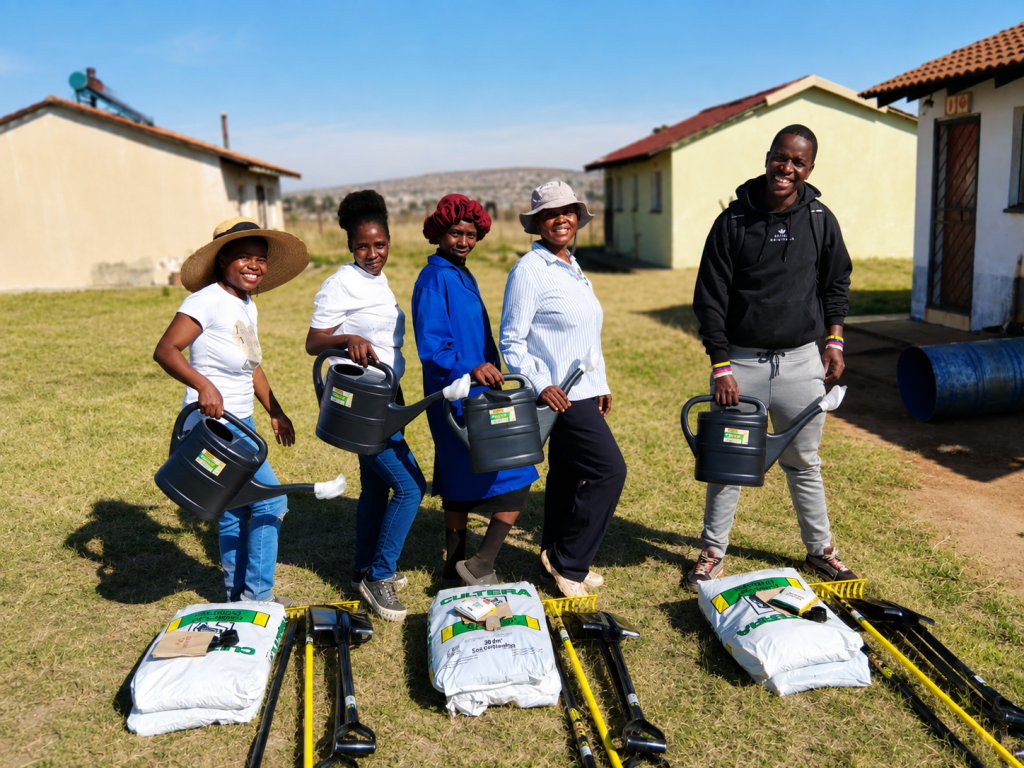
Through the initiative, approximately 120 people from Tjovitjo and Thulamntwana were assisted in securing essential gardening tools, with assistance from the Gauteng Department of Agriculture and Rural Development.
The tools may appear simple, but for someone trying to establish or maintain a productive home or small-scale garden, access to the right equipment can make an enormous difference.
A garden cannot be productive if people are expected to work without the basic tools needed to prepare soil, plant, cultivate, maintain and harvest crops.
This initiative therefore represents more than the distribution of gardening equipment. It is part of a broader effort to strengthen the capacity of ordinary people to become active participants in their local food systems.
From Home Gardens to Food Sovereignty
The CLASA Home Gardens Initiative is connected to a much broader conversation taking place across South Africa about food sovereignty, agroecology, sustainable food production and community resilience.
The South African Food Sovereignty Campaign (SAFSC) emerged from the need to unite organisations, social movements, small-scale farmers, farmworkers and NGOs working to advance food sovereignty in South Africa.
According to the SAFSC, its objectives include tackling the systemic roots of hunger, advancing food-sovereignty alternatives from below, creating a united platform for organisations and communities, and building a food-sovereignty alliance led by people affected by hunger, small-scale farmers, landless people and workers.
This way of thinking places an important question at the centre of food production:
How can communities become more capable of producing, accessing and shaping the food systems on which they depend?
The answer does not necessarily begin with a large commercial farm.
It can begin with a household garden.
It can begin with a small plot behind a home.
It can begin with neighbours sharing seeds, knowledge and tools.
And it can begin with people recognising that the land around them can become a source of food, learning, dignity and opportunity.
The SAFSC’s work has also included promoting agroecology, seed saving, community gardens and small-scale farming as practical pathways towards food sovereignty. Its food-commons platform currently documents community gardens, home gardens and small-scale farming initiatives in different parts of South Africa.
These ideas provide important context for understanding why supporting home and small-scale gardeners matters.
The Influence of Agroecology
At the heart of this approach is an understanding that sustainable food production is about more than simply putting seeds into the ground.
Agroecology looks at farming as an interconnected system involving soil, water, biodiversity, people, knowledge and local resources.
It encourages farmers and gardeners to work with natural processes, improve soil health, reduce unnecessary dependence on expensive external inputs and make better use of resources available within the community.
These principles have been explored extensively through initiatives such as iZindaba Zokudla, a Johannesburg-based multi-stakeholder initiative focused on urban agriculture, sustainable food systems, farmer learning and food-system innovation.
Among its activities is work around agroecological production for urban and small farms, bringing practical knowledge and technologies into conversations with farmers and other food-system participants.
This is particularly relevant to communities such as Tjovitjo and Thulamntwana.
Small-scale and home gardeners often work with limited land, limited financial resources and limited access to agricultural inputs.
Agroecology offers another way of approaching those challenges — by asking how local knowledge, natural resources, biodiversity, recycling, soil health and cooperation can become part of the solution.
From Knowledge to Practical Action
The ideas surrounding food sovereignty and agroecology become meaningful when they translate into practical action.
A gardener may understand the importance of healthy soil but still need a tool to prepare it.
A household may want to grow vegetables but lack the equipment needed to establish a productive garden.
A small-scale farmer may have land and experience but struggle to maintain production because basic agricultural tools are expensive.
This is where initiatives such as the CLASA Home Gardens Initiative can make a practical difference.
By helping approximately 120 people across Tjovitjo and Thulamntwana gain access to gardening tools, the initiative addresses one of the immediate barriers faced by small-scale and home gardeners.
It provides something practical that people can use immediately.
But the longer-term value lies in what those tools make possible.
They make it easier to prepare land.
They make cultivation possible.
They support ongoing garden maintenance.
They help people turn available spaces into productive spaces.
And they give gardeners an opportunity to build on their existing knowledge and experience.
A Garden Is Also a Story
The impact of the initiative is perhaps best understood through the experiences of the people who are already farming.
One example is Gugulethu Nshavhe, one of many small-scale farmers in Tjovitjo and one of the beneficiaries of the CLASA Home Gardens Initiative.
Gugulethu’s story demonstrates how farming can grow from personal experience, family knowledge and determination.
Growing up, she learned about farming from her grandmother. She later began cultivating a small piece of land in Tjovitjo, planting crops including beans, maize, tomatoes and spinach.
Her story is featured in our recent community article:
Land Is Life: Gugulethu’s Farming Journey in Tjovitjo
Gugulethu describes the importance of land and the ability to use her own hands to provide food for her children. Her experience demonstrates how a small piece of land, agricultural knowledge and practical support can combine to create an opportunity for household food production and further development.
Her journey is only one story among many.
Behind the figure of 120 beneficiaries are people with their own experiences, aspirations and reasons for growing food.
120 People, One Growing Community
Approximately 120 people from Tjovitjo and Thulamntwana benefited from the initiative through access to gardening tools.
Behind that number are individual gardeners.
There are people growing vegetables to supplement household food.
There are small-scale farmers trying to expand production.
There are community members interested in learning how to grow healthier food.
There are gardeners passing agricultural knowledge to younger generations.
And there are residents who see unused or underutilised spaces not as empty ground, but as potential sources of food.
For some participants, the tools can make an existing garden easier to maintain.
For others, they may represent the beginning of a new gardening journey.
The initiative is therefore not simply about the physical equipment distributed.
It is about putting productive capacity into the hands of community members.
The Importance of Partnership
The Home Gardens Initiative also demonstrates the importance of collaboration between community organisations, government and local residents.
CLASA played an active role in mobilising and supporting the community around the initiative, while assistance from the Gauteng Department of Agriculture and Rural Development helped make access to gardening tools possible.
This kind of partnership can connect community-level knowledge and participation with public-sector resources and agricultural support.
For communities, this matters because local organisations are often closest to the people they serve.
They understand local circumstances.
They know community networks.
They can identify people who are already taking initiative.
And they can help connect programmes with residents who can benefit from them.
For CLASA, this reflects an important principle:
Community development should not simply happen to communities. Communities should participate in shaping it.
The Role of Tjovitjo and Thulamntwana Organisations
The Home Gardens Initiative also highlights the importance of active participation by organisations and community structures based in Tjovitjo and Thulamntwana.
Community development becomes stronger when local organisations are not merely recipients of programmes, but active participants in identifying needs, mobilising residents, sharing information and building partnerships.
The involvement of community-based organisations creates opportunities for agricultural initiatives to become connected to the wider social fabric of the community.
Gardening can therefore become connected to:
- food-security initiatives;
- youth development;
- skills development;
- community education;
- small-business development;
- household resilience;
- environmental awareness;
- community markets; and
- local livelihood opportunities.
The garden becomes one part of a much larger community-development ecosystem.
Why Food Sovereignty Matters at Community Level
Food sovereignty is a much broader concept than simply producing vegetables.
It asks communities to consider their relationship with food — where food comes from, who produces it, who has access to land and resources, what knowledge is valued, and how communities can participate in shaping their own food systems.
The SAFSC has specifically promoted the idea of building food-sovereignty alternatives from below, with grassroots communities, small-scale farmers and other organised groups playing an active role.
Its work has also connected food sovereignty with agroecology, seed saving, community gardens and small-scale farming.
At the level of Tjovitjo and Thulamntwana, these ideas become practical.
They can mean a household growing spinach.
A farmer saving seeds.
Neighbours sharing knowledge.
A community member teaching another person how to prepare soil.
A young person discovering an interest in agriculture.
Or a small-scale farmer finding a way to turn production into a livelihood.
Food sovereignty therefore becomes something people can experience through everyday community action.
Learning, Sharing and Growing
The wider experience of iZindaba Zokudla also demonstrates the value of creating spaces where farmers, researchers, activists, entrepreneurs and other stakeholders can share knowledge.
Its work around urban and small-farm agroecological production includes practical agricultural approaches and technologies that can be explored by farmers working in urban environments.
This type of knowledge exchange is important for communities like Tjovitjo and Thulamntwana.
Providing tools is one step.
Building knowledge is another.
Creating opportunities for gardeners to learn from one another is another.
Over time, these relationships can help transform individual gardens into a wider community network of food producers.
From Tools to Skills, From Gardens to Opportunities
A gardening tool is valuable because of what it enables someone to do.
A spade enables someone to prepare soil.
A hoe enables cultivation.
A wheelbarrow enables the movement of soil, compost and harvested produce.
But tools become even more valuable when combined with knowledge about:
soil health, composting, water management, seed saving, crop diversity, pest management, planting methods and sustainable production.
That is why the Home Gardens Initiative should be viewed as part of a longer journey.
The immediate intervention is access to tools.
The broader objective is building capable, knowledgeable and resilient community food producers.
Over time, productive home and small-scale gardens can contribute to household food security, improved access to fresh produce, community learning and, where production allows, small-scale income-generating opportunities.
Building a Culture of Food Production
There is also a cultural dimension to this work.
For generations, many South African families have maintained traditions of growing vegetables, saving seeds and using available land to supplement household food.
Urbanisation, rising food costs, unemployment, limited access to land and changing lifestyles have made it increasingly difficult for some families to maintain these practices.
Community gardening initiatives can help reconnect people with that knowledge.
They can create opportunities for older generations to pass agricultural knowledge to younger people.
They can encourage children to understand where food comes from.
They can demonstrate that agriculture is not only something that happens on large commercial farms.
And they can create conversations about what a stronger and more sustainable local food system could look like.
A Shared Vision for the Future
The CLASA Home Gardens Initiative brings several important ideas together:
Food Security
Helping households and communities produce some of the food they consume.
Food Sovereignty
Strengthening community participation and agency within local food systems.
Agroecology
Encouraging sustainable approaches that recognise the relationship between soil, water, biodiversity, farming practices and community knowledge.
Community Development
Supporting local people and organisations as active participants in identifying challenges and building solutions.
Partnership
Connecting community organisations, government, farmers, development partners and other stakeholders around practical opportunities.
These principles are reflected in the wider South African food-sovereignty and urban-agriculture movements. The SAFSC has promoted grassroots food-sovereignty pathways, while iZindaba Zokudla has created spaces for farmers and other stakeholders to exchange knowledge around urban agriculture and agroecological production.
The Work Continues
Providing gardening tools is an important beginning — but it is not the end of the journey.
The real opportunity lies in what happens next.
Will more gardens become productive?
Will gardeners share what they learn?
Will young people become more interested in agriculture?
Will households harvest more of their own food?
Will small-scale growers develop new markets?
Will communities save and exchange seeds?
Will gardens become spaces for learning and cooperation?
These are the possibilities that make the Home Gardens Initiative significant.
For CLASA and its community partners, the work is about continuing to support practical, community-led action that turns resources, knowledge and local participation into opportunities.
The story of these gardens is ultimately not just about tools.
It is about people.
It is about people taking an active role in producing food.
It is about communities building resilience from the ground up.
It is about knowledge being shared between generations.
It is about local organisations working together.
And it is about recognising that meaningful change can begin with something as simple — and as powerful — as a person planting a seed in the soil.
Growing Together
With approximately 120 people from Tjovitjo and Thulamntwana reached through the initiative, the CLASA Home Gardens programme demonstrates what can happen when community participation, practical support and institutional partnerships come together.
The work continues in the gardens, in the homes, in community spaces and among the people who are choosing to grow.
From a garden comes food.
From food comes resilience.
And from communities working together comes the possibility of a stronger and more sustainable future.
Learn More
Community Story
Read the story of Gugulethu Nshavhe and her farming journey in Tjovitjo and see how practical support through the CLASA Home Gardens Initiative has contributed to her farming journey.
South African Food Sovereignty Campaign
Visit the South African Food Sovereignty Campaign to learn more about food sovereignty, small-scale farming, community food systems and agroecology in South Africa. The campaign describes itself as a platform bringing together organisations, social movements, small-scale farmers, farmworkers and NGOs working to advance food sovereignty.
iZindaba Zokudla
Explore iZindaba Zokudla for information and resources relating to urban agriculture, food enterprises and agroecological production for urban and small farms.
Gauteng Department of Agriculture and Rural Development
For agricultural information and government programmes, visit the Gauteng Department of Agriculture and Rural Development and explore the agricultural support available to communities and farmers.
About CLASA
The Community Leaders Alliance, SA (CLASA) works to support community participation, local development, partnerships and practical initiatives that respond to challenges and opportunities identified within communities.
The Home Gardens Initiative forms part of this broader commitment to supporting community-led development, food security, skills, livelihoods and stronger local networks.
The work starts with the community. The growth starts with participation.
Leave a Reply